
Guilherme Gomes Haetinger
I am a joint PhD student between ETH Zurich's Game Technology Center and Disney Research | Studios, supervised by Prof. Dr. Bob Sumner alongside Dr. Martin Guay and Dr. Jakob Buhmann. I hold both a Bachelor's and a Master's degree in Computer Science from the Universidade Federal do Rio Grande do Sul in Brazil, where my work focused on asset deformation using numerical methods and efficient differentiable rendering under the supervision of Dr. Eduardo S. L. Gastal. My current work and interests revolve around machine learning and generative animation, building tools that improve artistic expression and directability. In my free time, I like to ride my bike around Zurich, play ball, and cook with friends!
Publications
Shaping Strands with Neural Style Transfer
Paper · Video · Project page
Abstract
The intricate geometric complexity of knots, tangles, dreads and clumps require sophisticated grooming systems that allow artists to both realistically model and artistically control fur and hair systems. Recent volumetric and 3D neural style transfer techniques provided a new paradigm of art directability, allowing artists to modify assets drastically with the use of single style images. However, these previous 3D neural stylization approaches were limited to volumes and meshes. In this paper we propose the first stylization pipeline to support hair and fur. Through a carefully tailored fur/hair representation, our approach allows complex, 3D consistent and temporally coherent grooms that are stylized using style images.
Controllable Neural Style Transfer for Dynamic Meshes
Paper · Video · Project page
Abstract
In recent years, animation movies are shifting from realistic representations to more stylized depictions that support unique design languages. To favor that, recent works implemented a Neural Style Transfer (NST) pipeline that supports the stylization of 3D assets by 2D images. In this paper we propose a novel mesh stylization technique that improves previous NST works in several ways. First, we replace the standard Gram-Matrix style loss by a Neural Neighbor formulation that enables sharper and artifact-free results. To support large mesh deformations, we reparametrize the optimized mesh positions through an implicit formulation based on the Laplace-Beltrami operator that better captures silhouette gradients that are common in inverse differentiable rendering setups. This reparametrization is coupled with a coarse-to-fine stylization setup, which enables deformations that can change large structures of the mesh. We provide artistic control through a novel method that enables directional and temporal control over synthesized styles by a guiding vector field. Lastly, we improve the previous time-coherency schemes and develop an efficient regularization that controls volume changes during the stylization process. These improvements enable high quality mesh stylizations that can create unique looks for both simulations and 3D assets.
Regularized Kelvinlet Inversion for Real-Time Image Deformation and Video Time Warping★
Abstract
We present a novel approach for image deformation and video time warping. Our technique involves the inversion of the nonlinear regularized Kelvinlet equations, leading to higher-quality results and time/space efficiency compared to naive solutions. Inversion is performed by a per-pixel optimization process, being inherently parallel and achieving real-time performance in Full HD videos (over 300 fps). We demonstrate our method on a variety of images and videos, in addition to discussing some important technical and theoretical details.


Theses
Extracting Displacement Maps through Differentiable Rendering and Dynamic Tessellation
Abstract
We introduce a Differentiable Rendering pipeline to leverage hardware tessellation when extracting displacement maps with respect to image-space gradients. This method allows us to use differentiable rendering to reconstruct displacement maps without the need for expensive remeshing steps. Instead, we define a dynamic tessellation level by analyzing the displacement texture throughout the optimization process. As such, our technique automatically understands where more subdivision is required, increasing efficiency by not tessellating low-curvature regions. We exemplify the use of our method to reconstruct mesh detail from sparse rendered views. Our results show that the use of tessellation allows us to save memory by requiring only a few vertices to be stored, and the ability to dynamically control density areas helps speeding up the optimization process.
Fast Iterative Inversion for Non-Linear Vector Fields Applied to Images, Videos and Volumes
Abstract
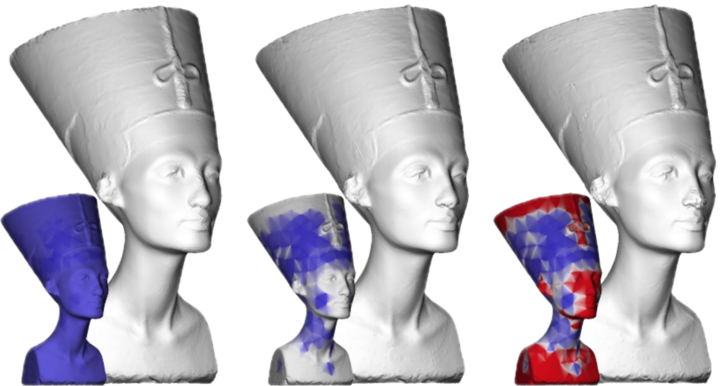
The demand for image manipulation applications and software has become a great incentive to the research and implementation of new methods that generate amusing/useful visual results. Filters, face morphing and video special effects have gathered immense attention in present times and are good examples of multimedia manipulation applications. However, processing visual data in a fast manner is a challenging problem due to ever-increasing resolution. This is something that has been worked on for a long time and solutions in high performance hardware and efficient algorithms have been elaborated. Our proposal aims to use both. We present a novel approach for image, video and volume deformation. Our technique involves the inversion of the nonlinear regularized Kelvinlet equations, leading to higher-quality results and time/space efficiency compared to naive solutions. Inversion for video and image transformations is performed by a perpixel optimization process, being inherently parallel and achieving real-time performance in Full HD resolution (over 300 fps). For volumes, we analyze whether the best approach is to compute in a per-pixel manner (i.e. in screen space) or to process the data before it is rendered, using CUDA kernels, in a per-voxel manner (i.e. in 3D space). We demonstrate our method on a variety of multimedia examples, in addition to discussing important technical and theoretical details along with practical usages.

Presentations
Visualization Dashboards with Pluto!
Abstract
Data visualization with intuitive interactions is an essential feature of many scientific investigations. I propose to go over use cases and examples on why/how to develop reactive dashboards in Julia using "Pluto.jl". Pluto provides a way to isolate cells in a separate page of which the style is editable as regular HTML/CSS. Alongside PlutoUI's experimental layout feature, this is a powerful tool to create immersive interactive experiences for users.
DesignByContract.jl: Enforcing interfaces between functions
Abstract
The Julia programming language has been evolving in many complex scientific fields. The rising adhesion of the language is a great opportunity to make Julia production-suitable. As an additional endeavor, I present a Design By Contract interface built entirely in Julia using its many features for Metaprogramming. My work takes the praised method of defining contracts to enforce interfacing between methods from Eiffel and hopes to extend it to different structures available in Julia.


Teaching
Informatik
- 2026-11-10Structs, recursion
- 2026-11-03Binary, floating point
- 2026-10-27Characters, recursion
- 2026-10-20References, vectors, matrices
- 2026-10-13Scopes, functions, past exam questions
- 2026-10-06Loops, Taylor series, scopes
- 2026-09-29For loops, expressions
- 2026-09-15Organizational information


